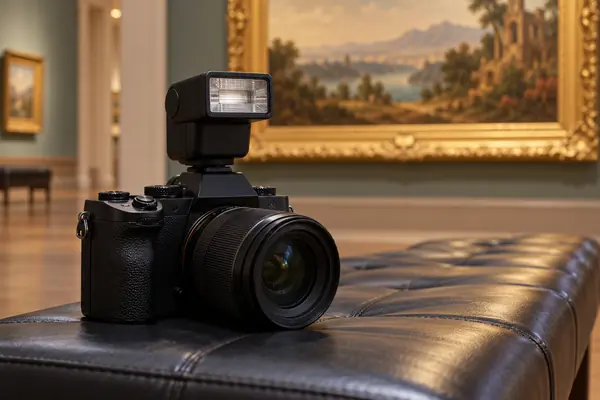
THE TEST
Same exposure, same fading
National Gallery tests exposed pigments to gallery light and to repeated flash until each had the same exposure. The fading was the same for every kind of light.
Compare the light newfullframecameras
WHAT THE TESTS FOUND
Light does fade paintings, but the flash is a tiny part of it.
Compare the light
SAME DOSEsame fading
Light damage adds up from how bright the light is and how long it shines. In 1995 the National Gallery in London tested pigments under gallery lighting and under repeated photographic flash. For the same total exposure, the fading was the same.
Updated
THE SHORT ANSWER
Three findings from gallery tests
and museum lighting rules.
THE TEST
National Gallery tests exposed pigments to gallery light and to repeated flash until each had the same exposure. The fading was the same for every kind of light.
Compare the lightFLASH
The gallery's photography guidelines permit flash for authorised professional work and prefer it to photo lamps, because the total light on the object is much lower.
See the limitsWHAT DOES HARM
Light damage depends on both intensity and length of exposure. Museums cut ultraviolet, lower light levels and keep sensitive items out of direct sun.
How museums manageA QUICK LIGHT CHECK
Pick a light source to see what tests and museum rules say about it. The bar shows how much it is likely to add to a painting's total light exposure.
Based on National Gallery tests and guidelines, the RAF Museum light policy and Dr Martin Evans as quoted by Art History News.
TWO NUMBERS WORTH KNOWING
Two limits from the National Gallery's
rules for photography and filming.
1,250 lux·s
Maximum light per flash frame on a painting
The gallery's guidelines set this as the most light any painting in the field of the flash may receive per frame, equivalent to f22 at 100 ASA.
FLASH · NATIONAL GALLERY
1,000 lux
Maximum from photographic lamps
Lamps must not exceed 1,000 lux on any painting in the field of the lighting, and 250 lux for particularly sensitive objects such as watercolours and works on paper.
LAMPS · NATIONAL GALLERY
Between shots, lamps must be switched off or reduced below 250 lux for most objects and below 50 lux for particularly sensitive ones. That is why flash, which is over in an instant, means less total light.

HOW MUSEUMS PROTECT WORKS
Damage to light-sensitive material cannot be avoided completely, the RAF Museum policy says, but it can be reduced. These are the measures museum policies describe.
UV is removed as far as possible with filters on windows and on artificial lights.
Light-sensitive objects are lit at lower illuminance, with visible-light filters where needed.
Reducing the total hours an object is lit matters as much as how bright it is.
Readings of UV and visible light are taken on a timetable and repeated each year.
SO WHY THE NO-FLASH SIGNS?
Dr Martin Evans concludes there are plausible reasons for a museum to ban flash, but that protecting the exhibits from harm is the least plausible of them. In the National Gallery tests, he notes, fading on the walls matched a small flashgun fired every 4 seconds from about 4 feet.
Art historian Bendor Grosvenor, who reported the findings, still supports flash bans in galleries, not least because of the disruption flashes cause other visitors. Following a museum's own photography rules remains the polite, and expected, thing to do.
Questions
National Gallery tests in 1995 found that pigments faded the same amount under flash as under gallery lighting when the total exposure was the same, and that modern flash units are not powerful enough to start two-photon degradation.
Its guidelines say electronic flash is preferred to photographic lamps because the overall exposure of the objects to light is greatly reduced.
Light damage depends on both intensity and length of exposure, and ultraviolet light is a particular concern. Museums reduce UV, lower light levels and shorten exposure times.
Dr Martin Evans, as quoted by Art History News, says phone flashes cannot be regarded as a conservation threat in a properly lit gallery.
Follow each museum's own rules. Many still ask visitors not to use flash, for example because of the disruption it causes other visitors.
ABOUT THIS NAME
newfullframecameras.com is part of the DoodleSale portfolio. It isn't in an auction right now, but you can ask about leasing it.